
Taylor Through a Calibrator's Lens — Part 1: What's Actually in the Cylinder
Taylor Through a Calibrator's Lens — Part 1: What's Actually in the Cylinder
There's something nobody tells you when you get into engine calibration — the further in you get, the more you realize how much there is to actually understand, and that this craft is its own trade with its own apprenticeship. Like an electrician or a plumber, you should expect years of building before things really click, and the learning never fully stops. Not just how to use the software, not just which tables do what, but the real physics underneath all of it. I got into this because I love it. Performance cars, motorsport engineering, the obsession with making an engine do exactly what you want it to do — that's what drives me to keep learning. I went to calibration schools, took courses, bought my own cars and ECUs, and cut my teeth building real experience from the ground up. That search for more never really ends, and picking up Taylor's The Internal Combustion Engine in Theory and Practice was just the next step in it — a foundational engineering text that's dense, rigorous, and genuinely fascinating once you have enough seat time to connect it to what you've seen in real data. What I keep finding is that the theory doesn't just explain the physics — it explains things I've seen in logs for years without fully understanding why. This series is me working through it out loud, translating what Taylor wrote in the 1960s into what it means at the ECU today.
---
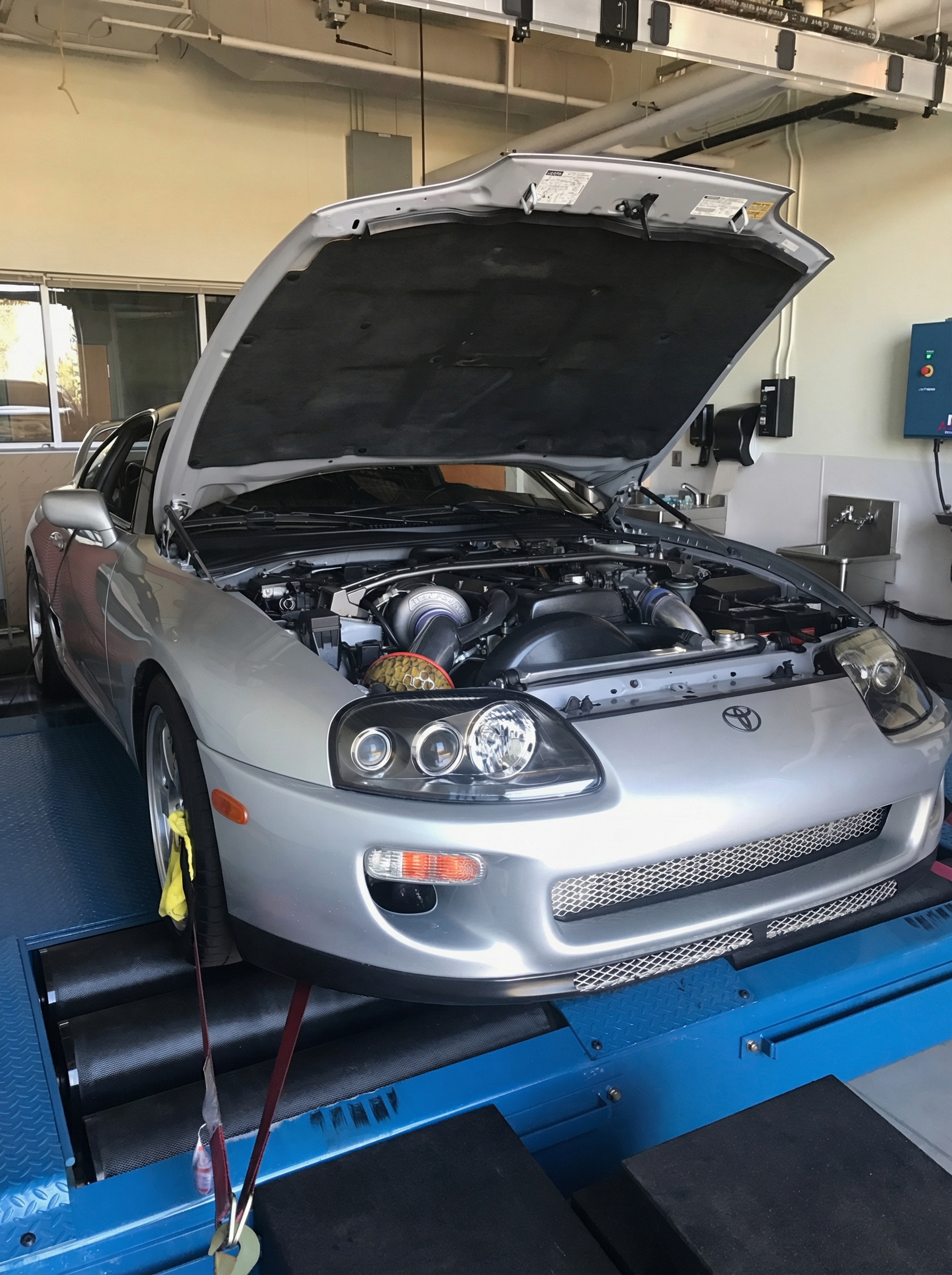
There's a point in a WOT pull on a 2JZ that I keep coming back to — a specific RPM and load where fueling changes didn't produce the response the numbers suggest they should. I was told it was harmonics. Maybe it is. But after working through Charles Fayette Taylor's Chapter 3 — the thermodynamics of fuel-air mixtures — residual gas fraction is now on my list of suspects too.
The working fluid inside the cylinder is not just air and fuel. Taylor is explicit about this from the start: it's a mixture of four things — air, fuel, residual exhaust gas from the previous cycle, and water vapor. Most ECUs model it as two. The VE table corrects for deviation from the ideal, closed-loop lambda adjusts fueling toward a target, and for large portions of the operating map that's close enough. But the simplification breaks down in ways that are predictable once you understand what the model is leaving out.
The residual gas fraction — the mass of leftover combustion products still in the cylinder when the intake stroke begins — is the variable most worth understanding. At high load on a well-scavenged engine it might be small enough that ignoring it costs nothing. At idle, at light throttle, or anywhere that cam overlap and exhaust backpressure are working against scavenging, it becomes a meaningful portion of the total charge. And it's completely invisible to the sensors the ECU has access to.
What residuals do is dilute the fresh charge. Less oxygen, slower burn speed, higher charge temperature going into compression because the residual gas is still hot. The knock relationship is counterintuitive at first — more residuals actually reduces knock tendency, because the dilution slows combustion and the heat capacity of the residual mass absorbs some of the pressure rise. At the same time, how consistently the burn develops cycle to cycle drops off. There's a region where residuals are doing you a favor on a knock-limited engine and a region where they're causing problems. Both can exist on the same map.
Taylor makes a point I hadn't considered before: water vapor behaves identically to residual gas in terms of its effect on the charge. Same dilution mechanism, same knock interaction. Which means a humid day and a high-residual condition look similar in the data. I'd understood that humidity affected knock — it's one of those things you absorb through experience — but I hadn't connected it back to the same underlying mechanism. Humidity is just external EGR you didn't ask for and can't measure directly.
The same logic applies at part throttle. Timing that's dialed in on a cool morning starts pulling knock in the afternoon heat. Residual fraction shifts with temperature, with backpressure, with cam position under thermal expansion — things the sensors don't capture and the model doesn't automatically adjust for. When behavior drifts without an obvious cause, residuals are worth considering before assuming the calibration is wrong.
None of this means every calibration problem comes down to residuals. But it does reframe what the VE table actually represents — not a description of how the engine breathes, but a correction applied to an ideal gas model that the real cylinder deviates from in ways that depend on pressure, temperature, chemistry, and timing simultaneously. Understanding that the model is a simplification — and specifically which simplification it is — is what makes it possible to work with it more honestly.
Taylor doesn't give you a sensor reading for residual fraction. The inputs needed to calculate it precisely — actual charge temperature at intake valve close, effective molecular weight of the mixture, true residual mass — aren't available on most platforms. What the chapter gives you instead is the framework for understanding why the cylinder doesn't always behave the way the model predicts, and that's worth more than it sounds. Once you see the charge as four components instead of two, you start reading the data differently — not looking for what's wrong with the calibration, but asking whether the model you're correcting against is even accounting for what's actually in the cylinder.
---
Source: The Internal Combustion Engine in Theory and Practice, Vol. 1 — Charles Fayette Taylor. Chapter 3: Thermodynamics of Fuel-Air Mixtures & Combustion.
Jason Bentley