Audi TT RS RSR Meets Syvecs S7: Full Standalone Build on the EA855 DAZA
Audi TT RS RSR Meets Syvecs S7: Full Standalone Build on the EA855 DAZA
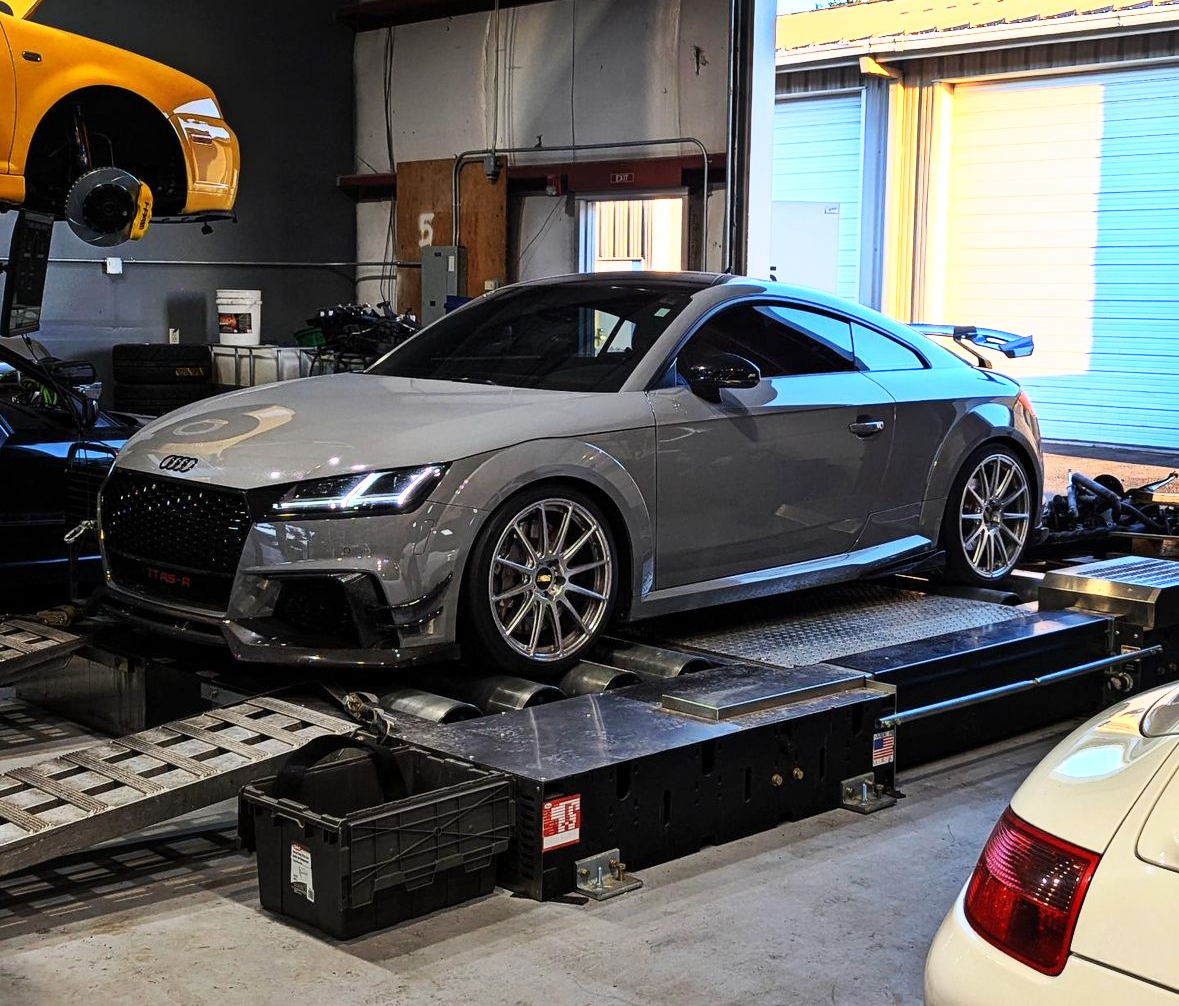
The Audi TT RS RSR, built around the 2.5-litre inline-five EA855 DAZA engine, is already a force of nature from the factory — but with the right hardware and calibration, it becomes something else entirely. Our client came to us for a Syvecs S7 standalone ECU installation along with a couple of custom wiring harnesses for additional sensors. From there, the car went on the dyno locally and we got to work extracting everything the build had to offer.
The Build
The Tuning Process
We started where every proper tune starts: a baseline pull and the Syvecs was running conservatively with no boost control active. The priority at that stage was confirming sensors, validating fueling, and ensuring the DI + port injection strategy was behaving correctly before pushing any harder.
DI + port injection on this platform means managing the high-pressure fuel pump (HPFP) and direct injection pressure (DI pressure — the fuel pressure feeding the injectors directly into the combustion chamber) alongside the port injectors. Early sessions involved dialing in DI pressure overshoot, fine-tuning fuel pump duty curves, and developing the relative fuel pressure compensation tables that keep fueling stable as the engine climbs through the rev range. One of the trickier challenges came during flex fuel pulls: we identified a lean spot at 5,200 RPM under high load where the stock port injectors were approaching their limit. Cross-checking the same RPM range on pump gas confirmed the lean condition was a fuel delivery ceiling on flex rather than a mapping error. Ultimately the fuel system was the limiting factor in how much power we could sustain — we were managing around it rather than through it, adjusting the flex blend targets and fuel pump strategy to stay within what the hardware could reliably deliver.
Once we got on to the track, air charge temperature (ACT) — essentially how hot the air is entering the engine — became a key variable to manage. Under sustained wide-open throttle, ACT was climbing toward 150°F by the end of pulls, which triggered our ignition timing compensation tables to pull timing back for safety. We refined those compensation curves carefully to protect the engine while preserving as much ignition advance as conditions allowed. Boost control also required iteration: early attempts at launch showed the car over-target by 30+ kPa, and we worked through the boost control PID and launch RPM targeting until behaviour was consistent and repeatable. A dedicated eight-position calibration switch was configured for the client — selectable boost levels in positions 1 through 4, a low-boost first-gear mode for low-traction conditions in positions 5 and 8, and data-logging modes embedded in positions 7 and 8.
The Results
The stock fuel system was the hard ceiling on this build. With the HPFP and stock injectors at their limit on flex fuel, the calibration was ultimately constrained by what the hardware could reliably deliver rather than what the engine or turbo were capable of. The numbers we achieved reflect that ceiling — a solid result given the fuel system, and a clear indicator of what becomes possible with upgraded injectors and a higher-flow HPFP. The launch control session demonstrated how well the boost control, launch RPM targeting, and transmission calibration all came together when the hardware is working in harmony.
Closing
This project covered the full scope of what we do — ECU installation, custom sensor wiring, dyno tuning, and ongoing calibration development. We work with Syvecs, Life Racing, EcuTek, and MoTeC across a range of builds. If you need a standalone ECU installation or tuning, we'd love to talk — reach out via our enquiry form to get started.